After writing an article about summer in Japan, I obviously couldn't skip writing about autumn, which is without a doubt my favourite season in this country — my season, really. It's only in the last few years that I've felt a strange kind of calm settle in as autumn arrives.
Back when I lived in France, I always thought of this season as the most depressing one of the year — the one tied to the school year starting up again, to skies that shut early, to that grey northern gloom that settles in and doesn't really lift until spring. Being from the north of France myself, and without wanting to feed the stereotype, weather-wise it really isn't the most pleasant season: first the days get shorter, then the weather, already often overcast in that region, turns properly gloomy. Wet dead leaves on the road are a genuinely diabolical combination, especially on a motorbike or scooter, and it's generally when everyone starts coming down with the usual round of colds, flu and other charming ailments that come with shorter daylight hours, the cold, the rain, and going back to work after weeks of vacation spent with your feet in the water or your head in the stars. In short, coming back to reality isn't always easy. But here, things are very different: autumn is the season when everything, finally, calms down.
An Autumn That Still Feels Like Summer
After the crushing humidity of July and August, which I describe in The Summer That Sticks to Your Skin, the temperature drop is gradual, almost generous: it's not unusual to still be walking around in a t-shirt in the parks in late October, even early November, with highs still hovering around 20-25°C. People go out again, walk again, rediscover the pleasure of spending time outdoors without mentally mapping the shortest route between two konbinis to escape the heat. The AC units, for their part, get switched off one by one — not all at once, but as a kind of signal that you can finally breathe, and shave a little off the electricity bill while you're at it. Unlike Europe, the daylight here stays bright and the weather mild for a good while longer.
Japanese nature in autumn is probably some of the most extraordinary I've had the chance to see anywhere — just behind Canada's, and its incredible forests, if I had to guess at a ranking. Koyo (紅葉) — the turning colour of the leaves in autumn, and by extension the season itself, when people set out to admire blazing maples and ginkgos — draws hikers from all over the world every year: over the decades, Japan has become a genuinely recognized destination for hiking, trekking and even camping during peak leaf season — on a level that, I think, has little to envy in the great North American classics.
In the article about summer, I talked about My Neighbor Totoro; autumn, for me, brings to mind a different Miyazaki film instead — Princess Mononoke, and that Forest Spirit whose every step makes the undergrowth bloom and then wither behind it, an image of nature changing while the little kodama (tree spirits) watch its passing in silence.
Koyo: The Zen of Japanese Autumn
There's something particular, distinctly Japanese, that I've noticed after years of living here. The changing of the seasons, however quiet, is remarkable — in the literal sense of the word: it simply can't go unremarked. And the Japanese have become masters at adapting to the seasons and weaving them into everyday life, as if to mark the passage of time. Kyoto's great Zen temples, Tofuku-ji among them, are a good example of that: the striking contrast between a dry garden's raked gravel and the red-and-orange blaze of maples above gives the season a meditative quality. You go less to look than to stop and contemplate.
“You go less to look than to stop and contemplate.”
When you visit old Japanese houses and temples, take the time to stop. Sit down, and watch, from the tatami, that opening onto an exuberant nature. Take in the smells that mingle there — wood, trees. If you manage to visit these places at a quiet hour, alone, enjoy the shōji, those wide sliding screens; walk along the engawa, that narrow veranda running between the inside and the garden, which makes it feel like the garden isn't just something behind a window, but that it's entering the house. This architecture, unique to Japan, blends with nature — it's built so you can live with it.
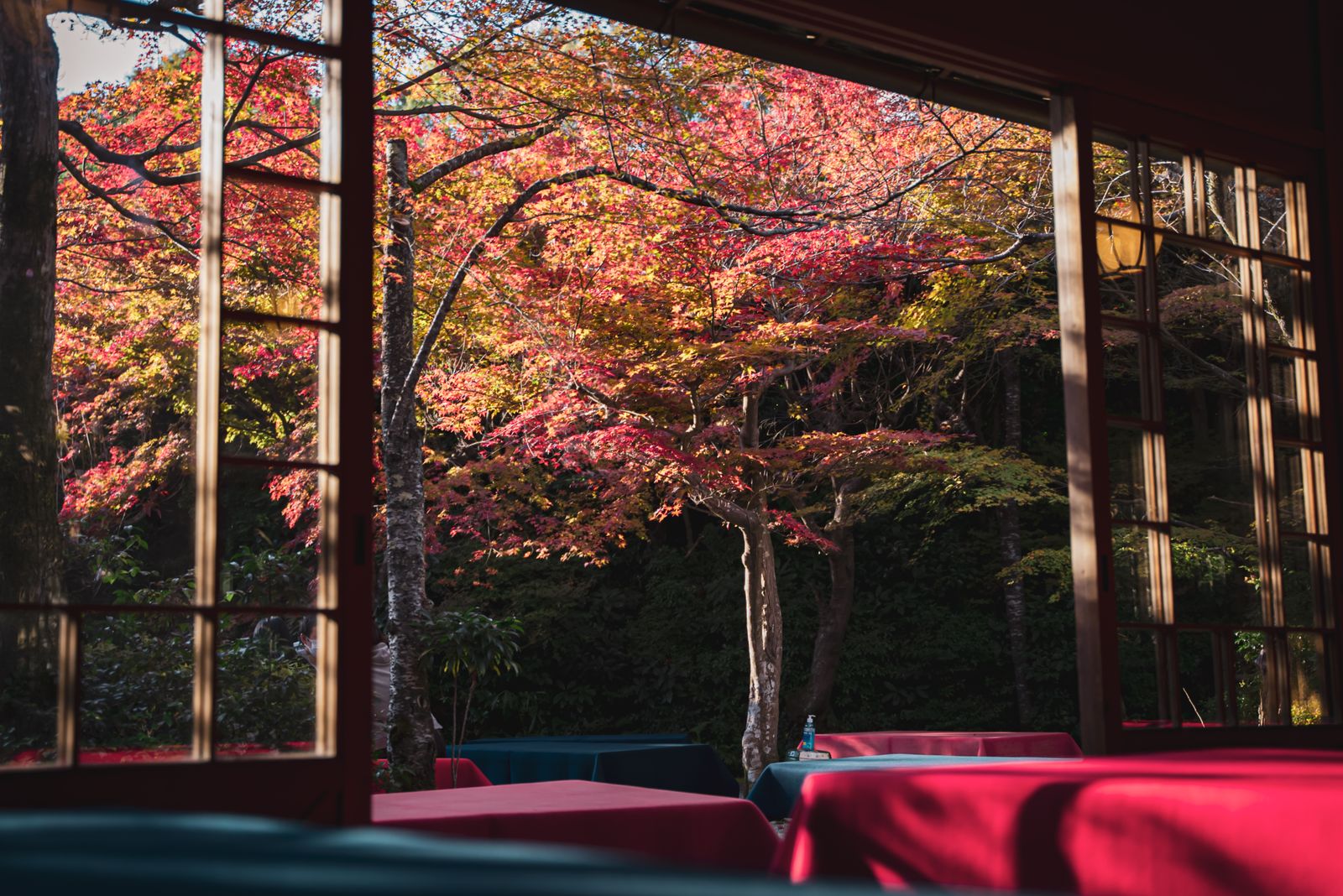
It's particularly striking in autumn. Sitting facing the garden, you watch nature change before your eyes, putting on its finest colours one last time before winter's coat comes down. There's nothing in particular to do. You just stay there. You drink a cup of tea.
Maybe koyo isn't just about pretty red leaves, after all. It's also an excuse to stop, look up, and reconnect — if only for a moment — with something our daily lives have made us forget.
Modern life makes it almost possible to forget nature altogether: you go from a train to an office, from one screen to another, from an air-conditioned building to a heated one, without ever really noticing the seasons have changed.
That capacity for contemplation surely owes something to Buddhism and Zen, especially in certain temples and gardens; that closeness to nature also traces back to older traditions, ones often associated with Shinto.
Japanese has a whole set of expressions for autumn, depending on what you associate it with: 食欲の秋 (shokuyoku no aki), “the autumn of appetite”; 読書の秋 (dokusho no aki), “the autumn of reading”; スポーツの秋 (supōtsu no aki), “the autumn of sport”; 芸術の秋 (geijutsu no aki), “the autumn of the arts”; or 行楽の秋 (kōraku no aki), “the autumn of outings.” The point isn't the vocabulary itself: these expressions mostly say that after summer's suffocating heat, autumn seems to reopen a whole space — for eating, walking, reading, creating, getting outside. Japan, in short, breathes again.
Fireworks, Shichi-Go-San and Autumn Treats
Contrary to popular belief, Japanese autumn isn't entirely without fireworks. The Tsuchiura festival, in Ibaraki prefecture, has run one of the country's most prestigious hanabi competitions since 1925, every year deep into autumn. Some major summer fixtures have even migrated toward this milder season: the Yodogawa hanabi in Osaka recently moved its date to October, when milder temperatures bring families back out in force.
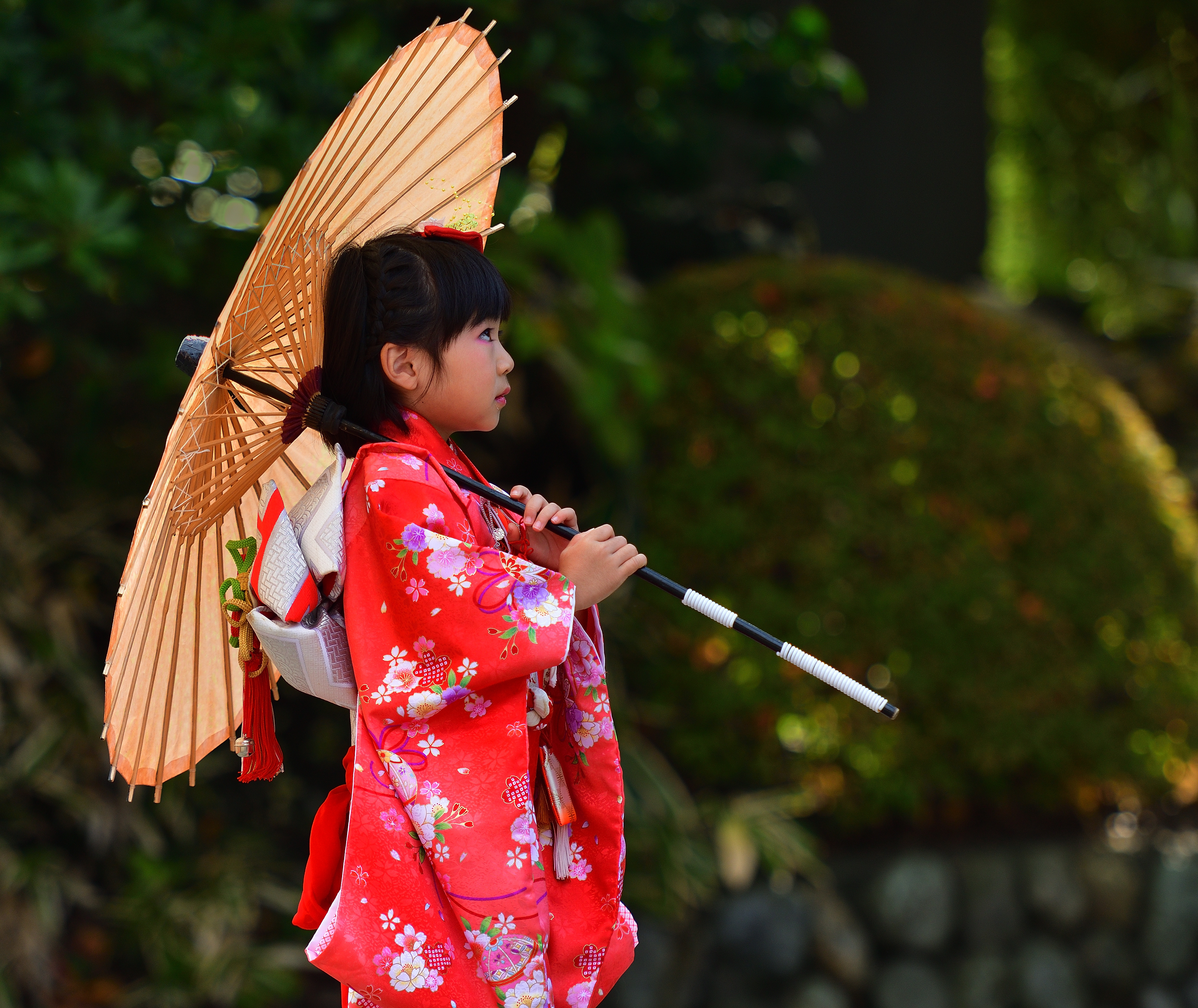
Autumn is also the season of Shichi-Go-San (七五三), literally “seven-five-three,” delighting kids and grown-ups alike — a celebration marking an important milestone for children of those ages. In mid-November, families head to the major Shinto shrines, dress their children in kimono, and spend the day taking photos. If that's of interest, our partner photographer regularly captures scenes like these throughout the seasons.
On the food side, autumn has its own must-haves: charcoal-grilled dango sold along hiking trails, matsutake mushrooms flooding the markets, and kaki, the orange persimmon you'll see drying under eaves in the countryside. And then there's Oktoberfest — a festival imported from Germany but thoroughly embraced by Japan, which runs editions in major cities throughout October, one more excuse to get together with friends, colleagues, and everyone in between.
On one side, the maples, the temples and Shichi-Go-San; on the other, Oktoberfest pints, soon followed by Halloween costumes — without ever becoming Japanese traditions themselves, these imports from elsewhere have found their own place in the country's seasonal calendar too.
Halloween has grown, in recent years, into something genuinely pharaonic in Japan — enough that authorities have had to impose restrictions at Shibuya Crossing, one of the country's most iconic gathering points for the occasion, which hasn't stopped revelers from showing up there anyway. Since October 2024, drinking in the street there has been banned, and enforcement has tightened every year since. Authorities regularly cite the 2022 Itaewon crowd disaster in Seoul as justification for these preventive measures.
Japanese summer sticks to your skin; autumn, at last, seems to give it back. Once that spike of activity around Halloween passes, onsens become natural refuges again as the air cools, light jackets replace t-shirts, and nature, quietly, gets ready for winter.
A Few Practical Pointers
- Koyo varies by region and altitude: as early as the start of October at higher elevations (Oku-Nikko), from mid-November to early December for Tokyo and Kyoto, depending on the year.
- For a standout trip from Tokyo, head to Nikko (about 2 hours by train from Asakusa) — the UNESCO-listed Toshogu shrine offers a striking contrast between its gilding and the blazing maples around it; Kegon Falls and Lake Chuzenji are also worth the detour.
- Looking for something simpler, without a long trip? Mount Takao, under an hour from Shinjuku, remains a reliable choice for a short hike in full colour.
- For the contemplative experience, Kyoto's great Zen temples (Tofuku-ji chief among them) remain among the most beautiful places to stop and contemplate — aim for a weekday, since late-November weekends get overrun.
Four bilingual (FR/EN) self-guided itineraries built around Slam Dunk, Hikaru no Go, Your Name & Persona 5 — maps, timing, budgets included.